Fatherhood and parental responsibility
The Journey CollectionFatherhood and parental responsibility is the moral center of Travis McCoy’s return to Clarendon. The revelation that Max is his biological son does not immediately make Travis a father in the fullest sense. He must confront the ten years he missed, answer for the choices that left Penelope Stone to raise Max alone, and decide whether fatherhood will remain a fact of blood or become a sustained practice of love, protection, accountability, and presence.
Definition and Initial Absence
Fatherhood in the story is defined by the gap between biological connection and lived responsibility. Travis McCoy learns that Russ McCoy knew Max was his son after seeing Penelope Stone with a baby the summer after Travis left. Russ had repeatedly considered calling, but did not, while Penelope had discovered the pregnancy two months after Travis’s departure and had been unable to bring herself to tell him. The information reaches Travis only after ten years, making his first encounter with fatherhood inseparable from belated knowledge and irreversible loss.
The absence has a concrete emotional cost. Travis McCoy recognizes that he missed Max’s first steps, never taught him to catch a baseball, and never heard him call Travis “Dad” during his first decade. His anger is also shaped by an earlier family wound: he had been nine when Loralie McCoy was diagnosed with Acute Lymphoblastic Leukemia and eleven when she died after two years and numerous rounds of chemotherapy. Travis believed Russ had abandoned Loralie during her illness, and that judgment helped form his own fear of parental failure. His resentment toward his father therefore becomes a warning about the kind of father he does not want to be.
The Ethical Decision to Become a Father
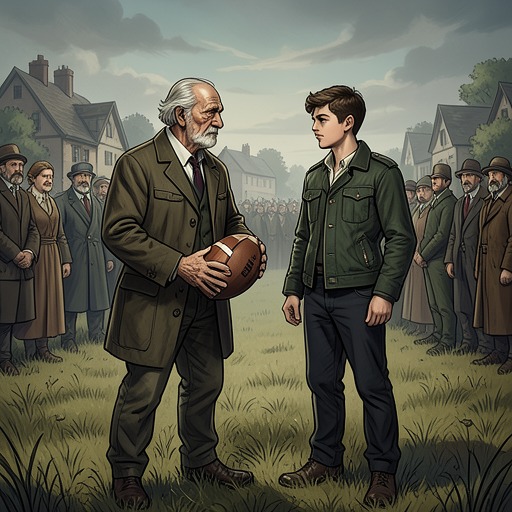
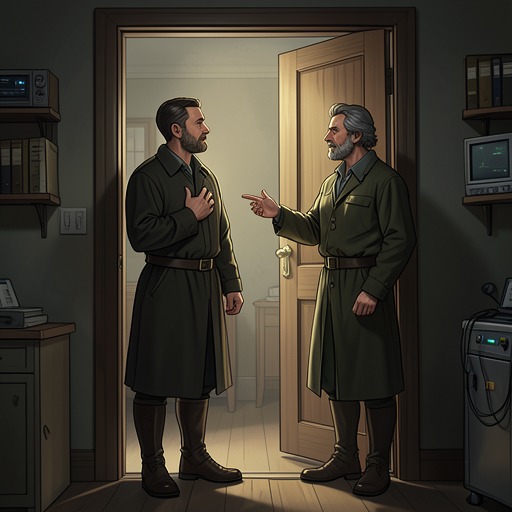
When Russ McCoy asks whether Travis will make Max part of his life, Travis cannot offer an immediate plan. Until the previous day, he had not known he had a child, and he admits that his professional life is already in turmoil. Russ nevertheless insists that Max is an exceptional boy, “full of fire and gumption,” and warns Travis not to toy with his emotions. The question turns fatherhood into an obligation that must be chosen and enacted, not merely claimed.
Max himself makes the hidden relationship visible. During a meal, he asks Travis when Travis intended to tell him that he was his father. Max has inferred the truth from Penelope’s emotional reaction whenever the Miami Sharks played and from photographs kept in a box beneath her bed. Rather than responding with anger, Max says that Travis is present now and that they can become a real family. Travis answers with his word that this will happen, while Max immediately establishes a reciprocal moral condition: Travis must not hurt Penelope, because she has cried enough already. The child is therefore not passive in the family’s reconstruction; he evaluates Travis’s promises and demands that they carry weight.
The decisive test comes when Travis prepares to leave temporarily. Max asks whether he is going to leave again, and Travis sits beside him on the porch to say that he is not abandoning them. When Max asks whether home means staying with Max and Penelope, Travis accepts that definition and asks whether they will have him. Max embraces him, explains that he has been waiting for Travis to come home, and says that both he and Penelope need him. Travis responds that he needs them as well and promises not to leave Max again. The exchange turns home from a place into a chosen responsibility.
Presence, Trust, and Repair
Travis McCoy’s new fatherhood is repeatedly measured through ordinary moments of presence rather than through declarations alone. At the elementary school, he dreads saying goodbye to Max even though the separation is supposed to last only a few days. Max’s anguish mirrors Travis’s own expression, and the boy asks whether Travis will return for good. Travis answers that he will be there forever, promises it, and tells Max that he loves him. Max replies in kind before running into the school. The scene revises the meaning of Travis’s earlier departure: leaving is no longer an unexamined pursuit of football, but a situation that must be explained, limited, and followed by return.
Russ McCoy eventually recognizes the difference between Travis’s athletic achievement and his parental potential. He tells Travis that although Travis is a great quarterback, he will be an amazing father, while also admitting that Russ himself was not the father Travis needed. Russ attributes his failure to being lost in grief after Loralie McCoy’s death and urges Travis to make up for the years Max has lost. Travis rejects the idea that ten years can simply be restored, but promises not to miss more of Max’s life than necessary. He identifies Max and Penelope as everything to him, making parental responsibility the principle by which his future will be measured.
The state championship gives Max a public moment of recognition. After the Clarendon Broncos complete a successful two-point conversion, Max climbs onto the bench, embraces Travis’s neck, and thanks him as his father. Travis understands that Max has had to learn to trust him not to leave and not to hurt Penelope, but above all to trust that his love is genuine. Travis replies that Max, not football, brought him home. The moment joins paternal identity to mutual transformation: Travis chooses fatherhood, but Max also becomes the person who makes Travis’s return and reorientation possible.
Family Identity and Institutional Commitment
Travis’s responsibility expands from affection toward Max to the formal construction of a family. Before marrying Penelope Stone, he proposes legally changing Max’s last name to McCoy. He acknowledges why Penelope had given Max her surname, but argues that if Penelope is to become a McCoy, Max should be one too. The request distinguishes biological paternity from legal and social belonging while presenting the surname as a public sign of family unity. Penelope accepts, and the planned conversation with the judge gives Travis’s desire an institutional form.
His commitment to Penelope is also part of his parental responsibility because Max has made Penelope’s well-being a condition of the relationship. Max explains that before Travis returned, Penelope was lonely, rarely smiled or laughed, and sometimes cried where she thought Max could not hear. He tells Travis that he never wants to hear her cry that way again. Travis assures him that he would never hurt Penelope and that he loves her. Max’s warning makes clear that Travis is not entering an isolated father-son bond; he is joining and protecting an existing mother-and-child household.
At Travis and Penelope’s wedding, Reverend Brown leads the couple into marriage vows concerning love, hardship, sickness, health, and changing circumstances. Max stands between them to light the eternity candle, turning the ceremony into a shared family act rather than merely a romantic union. The marriage therefore completes a sequence that began with concealed paternity: discovery becomes conversation, conversation becomes promise, promise becomes legal inclusion, and legal inclusion becomes a publicly witnessed family structure.
Intergenerational Responsibility and Ending
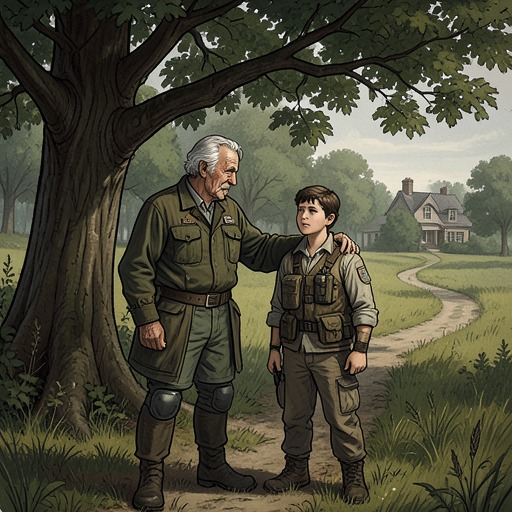
The concept reaches beyond Travis McCoy and Max McCoy to the older generation. Russ’s letter recalls a moment when four-year-old Travis wanted to ride on the tractor. Russ initially intended to postpone the promise because of farm work, but Loralie McCoy warned him that his son would be gone before he knew it. Russ found a picture of himself and Travis clenched in the sleeping child’s hand, took Travis into the field the next day, and later confessed that he had always been proud of him. The memory gives fatherhood a generational pattern: Russ’s failure to recognize time and Travis’s absence from Max’s early life are linked, while Loralie’s intervention supplies the principle that attention must be given before childhood disappears.
Travis’s response is not to claim that he can erase the past. He accepts that he cannot recover Max’s first ten years, but he can refuse to repeat the loss. That distinction makes his fatherhood reparative without making it magically restorative. Responsibility consists in acknowledging what cannot be recovered and changing what can still be changed.
By the family gathering after the wedding, Travis sees himself surrounded by a mother and father, a son, a wife, and a baby on the way. The household now includes repaired parent-child bonds, a marriage, and an approaching new generation. Fatherhood has consequently moved from a concealed biological fact to a network of relationships sustained by recognition, promises, legal belonging, ritual, and continued presence. The final image of family completeness does not erase the earlier failures; it shows those failures being answered through a different pattern of care.